
Understanding Different Types of Advanced Recycling Technologies
Advanced recycling is often discussed as if it is a single technology. In reality, it refers to a broad group of processes designed to manage waste plastics and other materials in different ways. Broadly speaking, these technologies break plastics down into molecular building blocks (e.g., chemicals, plastic monomers, waxes, lubricants, or fuels), which can be used to offset virgin materials when making new products.
However, each of these technologies works differently, uses different inputs or “feedstocks,” produces different outputs, and has a distinct environmental profile.
Why Are Different Technologies Needed?
Some plastics (e.g., PET, HDPE bottles, and PP containers) can be mechanically recycled relatively easily when they are clean and sorted. Other plastics may be more difficult to process due to contamination, mixed materials, or product design (e.g., flexible films and wraps).
Advanced recycling technologies provide additional pathways for materials that may be difficult or impossible to process through traditional recycling systems.
As waste volumes continue to grow, policymakers, researchers, and industry stakeholders are exploring a range of approaches to keep materials in productive use. According to the OECD, global municipal waste generation is projected to increase from approximately 2.1 billion tons in 2023 to 3.8 billion tons by 2050 without further action.
Common Types of Advanced Recycling Technologies
Conversion
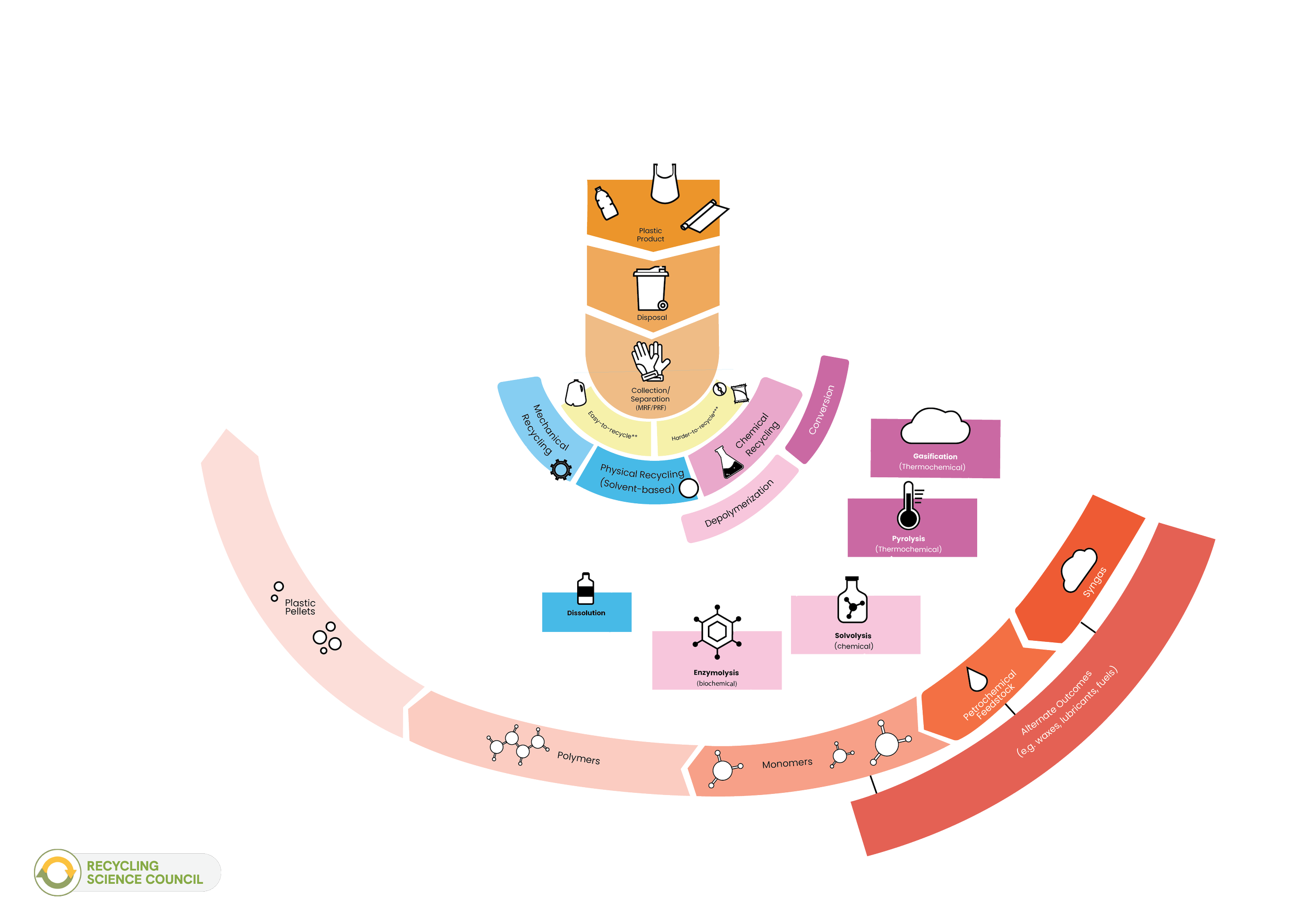
Conversion technology processes typically involve the thermal breakdown of the waste plastics in an oxygen-starved and combustion-free reactor, maintaining carbon in the final products of the conversion reaction (char, liquid oil, light gases and syngas) rather than releasing carbon as carbon-dioxide. These processes can also include catalytic steps to convert the liquid oil and syngas to select chemical products.
Pyrolysis
Pyrolysis uses heat in the absence of oxygen to break plastics down into liquids, waxes, or chemical feedstocks, which are raw materials that can be used in manufacturing and industrial applications, or further processed in existing refinery systems to produce chemical feedstocks. Depending on the process and outputs, these materials may be used to produce new chemicals, products, or other materials.Gasification
Gasification uses heat and controlled amounts of oxygen to convert materials into syngas, an energy-rich gas that can be used to produce chemicals, fuels, or other products.
Depolymerization
Depolymerization breaks plastics down into smaller molecular building blocks called monomers (for more of an explanation on these please visit here). These monomers can then be used to produce new materials.
Enzymolysis
Enzymolysis uses enzymes to break down plastics into smaller molecular building blocks called monomers. This approach is being explored as one potential pathway for processing certain types of plastics.Solvolysis
Solvolysis uses solvents (e.g., water or organic solvents) to break down polymers into smaller molecules such as monomers or oligomers. Depending on the process and material stream, these outputs may be used to produce new plastics or other materials.
Physical Recycling
Physical recycling uses solvents or other separation techniques to recover and purify plastics without breaking them down into smaller molecules. The recovered material can then be used in new products or manufacturing applications.
Dissolution
Dissolution uses solvents to separate and recover specific polymers from plastic waste without chemically breaking down the material. This process can help recover high-quality material from mixed plastic streams.
Different Technologies, Different Outputs
One reason advanced recycling can be difficult to define is that technologies use different feedstocks, employ different processes, and then produce very different outputs. Some outputs may be used to manufacture new plastics or chemicals. Other outputs may be used as a feedstock to existing refining or other industrial processes. And a fraction may be used as fuel, offsetting the use of virgin fossil feedstock, although this is not the primary goal of advanced recycling technologies. This distinction is one reason why advanced recycling is often discussed within broader recycling and waste management conversations.
A Growing Area of Research and Innovation
Advanced recycling technologies continue to evolve as researchers, companies, and policymakers explore different approaches to managing materials that may be more difficult to recycle through traditional systems alone.
Like other recycling pathways, these technologies involve tradeoffs, infrastructure needs, and ongoing discussions around policy, terminology, and material recovery. Understanding the differences between technologies is an important part of more informed conversations about recycling, circularity, and the future of waste management systems.